In this and my next posts I will be sharing what I learned by writing my new book The Sound of the Night, on this occasion I will talk a little about how I built the story. Before starting, I want to mention that the whole story is written according to the opinion I have of what a good story is, so I wrote using the characteristics that fascinate me.
I have read that there are two types of writers: Map and Compass. Map writers assemble everything (The world, sketches of each character and their attributes, if they will use an invented language, the laws that will govern the world, etc.) before starting the story. From everything they devised they begin a story under those premises; an example of this type of author is George R. R. Martin, writer of A Song of Ice and Fire (Game of Thrones). On the other hand, Compass writers have a story to tell, they know some details that will happen and maybe how it will end, and then they go “connecting the dots”; an example is the author Stephen King, writer of IT (the clown). No one is 100% one or the other, but both things are combined.
I didn’t know these concepts until I had already started my book, and I learned that I am more of the compass type. When starting the story I had the main idea, I knew what it was going to be about, how certain things like magic were going to work, also the things that would happen to the characters at certain points in the story, even how it would end… but I didn’t know how I would connect those dots. I had to build that as the story elapsed. Sometimes it was simple, but as I will explain in another article, in others it seemed as if the characters made their own decisions and ended up doing something that led them to another very different point than planned, causing the story to take a turn and open other paths. In these cases I tried not to force it so they would end up where I wanted, but from those new paths I traced a new script. In the end, many things in the story remained as in the beginning but many others changed totally. There were moments that even shocked me, as if someone were telling me the story and told me a fact I didn’t expect, like the death of some character. Although I am happy because the essence remained the same.
A complex part when writing is giving a personality to each character. At the beginning you think of a character and give them an initial personality, but as the story unfolds they acquire personality traits that are modified according to the things that happen to them; sometimes you end up with unrecognizable characters. Something I liked a lot was imagining what the characters would be like physically. I confess I had some problems with this, especially when trying to avoid going for the Caucasian appearances we are used to when reading fantasy (medieval European appearance). In this case, the characters have traits less explored in fantasy stories: Dark-skinned, short, with slightly slanted eyes, straight hair, beardless, etc. Another thing I tried is that the characters were like any person you would meet on the street. Of course, as in every story you will find some cliché, but with this I mean that you will not find the noble hero who only seeks good or the villain(s) who only seek to do harm (although there is a villain of this type, you will meet him), but normal people to whom extraordinary things happen: Iktan and Trop are two simple boys who just want to be vagabonds and are in their merchant facet, but that same thing is what leads them to go through everything that happens to them.
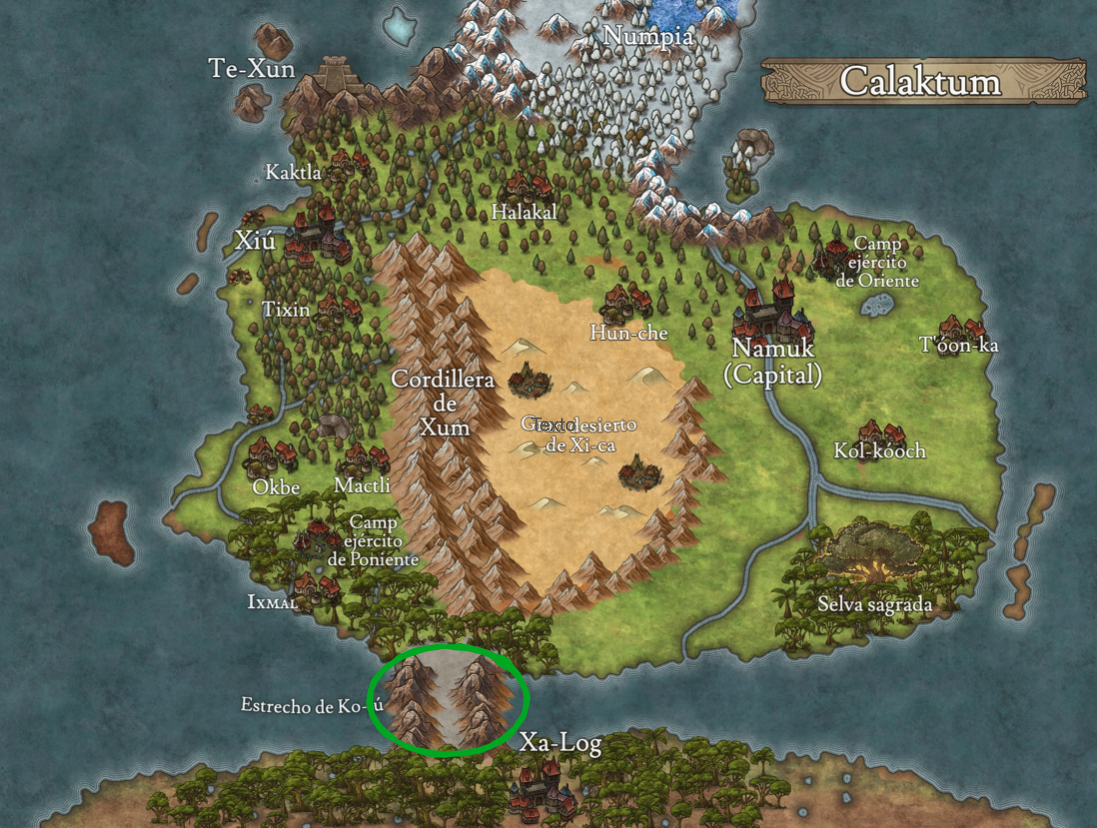
Regarding the nature of the world, I knew it would be set in a Pre-Hispanic world, inspired by the landscapes of Mexico and Latin America in general, especially the forested and jungle areas, but beyond that I didn’t know about its details. I discovered these also according to the story, trying to make it make sense but at the same time not seem like I was building it for the characters, but rather that it was a world that was already there and played for or against them. There are parts where the terrain is an important part of the story, an example is the strait of Ko-lú, a set of narrow mountains which at the beginning of the story helps the army repel the Nazor. By the way, one of the parts that complicated me the most were the distances: how far should one city be from another? how long would a person take walking or running? It would be very weird if the characters traveled the entire kingdom in a day, but they couldn’t take that long either, after all there was a war in progress and it couldn’t drag on forever. I had to investigate these types of things to make it make sense. As a curious fact, an average person walks at 6km/hr and can run up to 30km/hr if they run at full speed. Building the world was one of the parts I enjoyed the most. At some point, I will dedicate a post to give more details of this part.
Finally, one of the parts that I was most passionate about: Magic. A large part of the story revolves around magic and fantastic beings, although I will talk about this in another article so as not to make this one so long.
I hope you like the book El Sonido de la Noche and enjoy reading it as much as I did writing it.