Buy
Prices include shipping*
- Amazon shipping subject to having Prime. Price may vary depending on dollar to peso exchange rate.
- In the city of Culiacán you can also find it at Librerías México or directly from me.
420.00 |
99.00 |
Kindle 3,99 Physical 10,18 |
Kindle 4.90 Physical 10.99 |
War has come to Calaktum, the Nazor are very close now, no one knows what they seek, they already took Xa-Log, the great city of the South, and the only thing protecting the kingdom is the Coyote Army, fiercely defending their position.
But something strange is happening, it’s as if the Nazor appear one day to attack with all their power and the next day they disappear without a trace. Even so, the army’s forces are increasingly reduced and they would have already been defeated if not for a mountain range that functions as a natural defense and the help of the Tezcal, a group of warlocks who can do inexplicable things. With all this, it’s only a matter of time before the Nazor cross and the entire kingdom is at their mercy.
Iktan, like any other young man his age, doesn’t worry much about it. He and his friend Trop are more concerned with becoming nomadic traders thanks to his grandfather Bej who was also one and ignited that spark in them. But when Bej tells them the story of how he became a trader, an adventure emerges that leads Iktan and Trop to help him achieve a goal he’s had since his youth, one that turns out to be related to the war, even to the point of being able to change everything.
The World
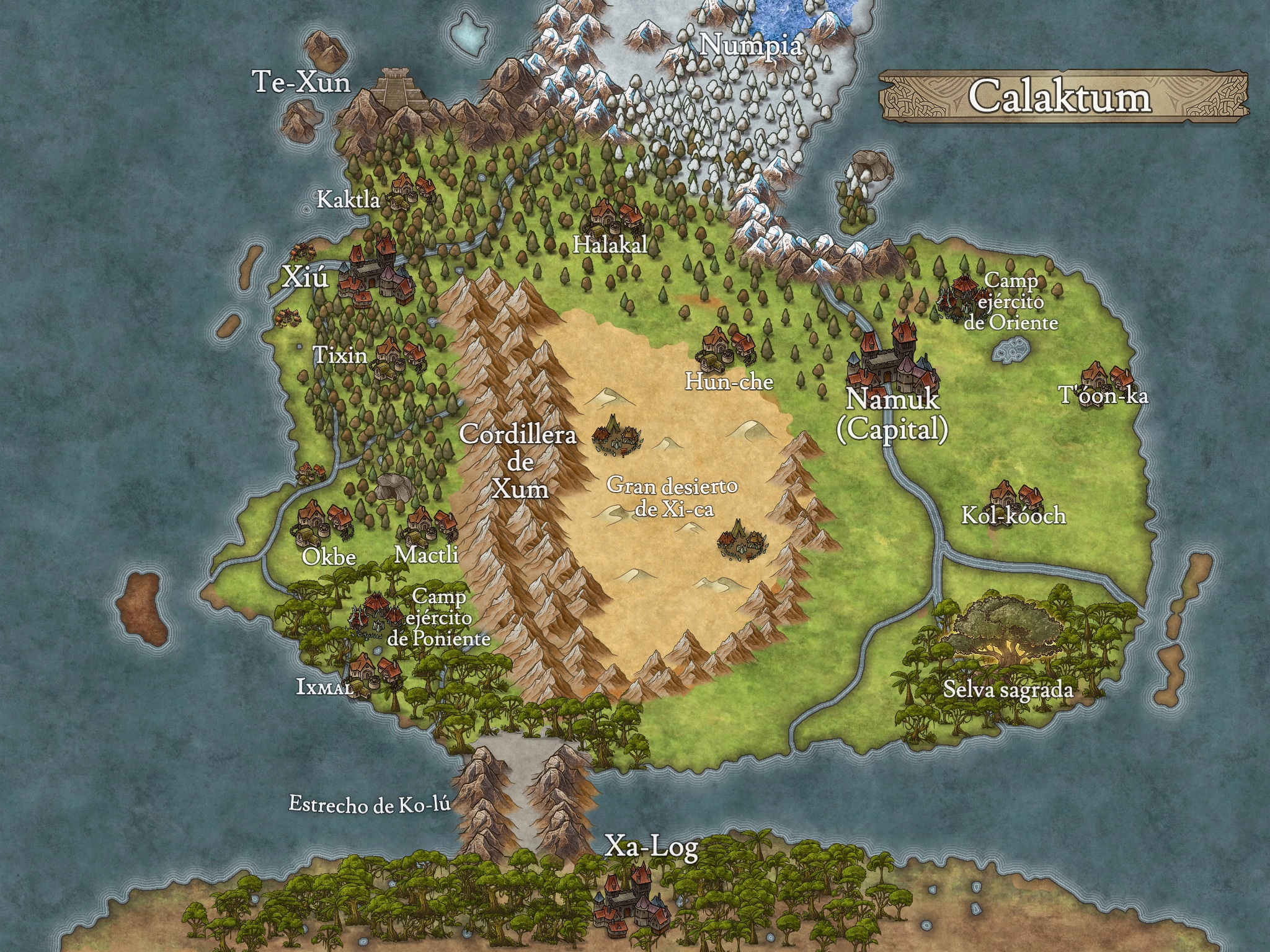
The story takes place in the kingdom of Calaktum, which, like Latin America, has a great diversity of ecosystems, from inhospitable deserts, through beautiful forests, to jungles so lush that it’s impossible to enter them without getting lost.
The Cultures: Why a Pre-Hispanic Fantasy Book?
Within my love for books there’s a special place for the fantasy genre. First, because it was this genre that introduced me to the world of reading, and second, because whenever I have a book of this style in my hands, I can’t stop reading and being amazed by the imagination of its authors. I’m fascinated by the worlds they create and how the entities included in them interact, and I’m not just referring to their characters but also to how politics, geography, the laws that govern the world, fictional beings… and magic work.
It’s incredible to read stories about knights and assassins fighting dragons, armies battling in service of ambitious kings, druids and sorcerers using their magic to stop monsters you couldn’t imagine even in your dreams, but that are presented to you so clearly that you now see them vividly, or political intrigues where betrayal and each character’s plans keep you on the edge of a cliff.
The idea of writing a book like this arose from the question: what would happen if these types of stories occurred in a pre-Hispanic world? Based on characters, mythological beings, legends and cultures unknown to almost everyone except the few towns where these beliefs still prevail, and that are so amazing they blow your mind. Of course, with a completely invented story, and with the main objective I seek in a fantasy book: that it’s fun to read and makes your imagination soar.
So I got to work and began researching these cultures, each and every one fascinating. From the beginning I had the main idea for the story, but then came the million-dollar question: which of these cultures do I relate it to? And like a true glutton and lover of mythologies, the answer came to me: why not all? So this story contains a mix of different cultures, mainly Mayan and Aztec, but also other smaller and less internationally known ones, such as the Rarámuri or Tlaxcalteca.
I tried my best to portray the way people from these cultures lived, aspects such as their customs, clothing, currency, hierarchies, etc. Of course, taking into account that this is a fantasy story and therefore has elements that might not be real or historically accurate. An example is the coacallis, or “Aztec inns,” of which there are no records until the year 1525 AD, after the arrival of the Spanish, but well, as I said before, the intention is to entertain.
Finally, I want to point out that everything I mention I do with the greatest respect and admiration for the cultures to which this story alludes. It’s an honor for me to have learned even a little of everything these cultures have to offer.
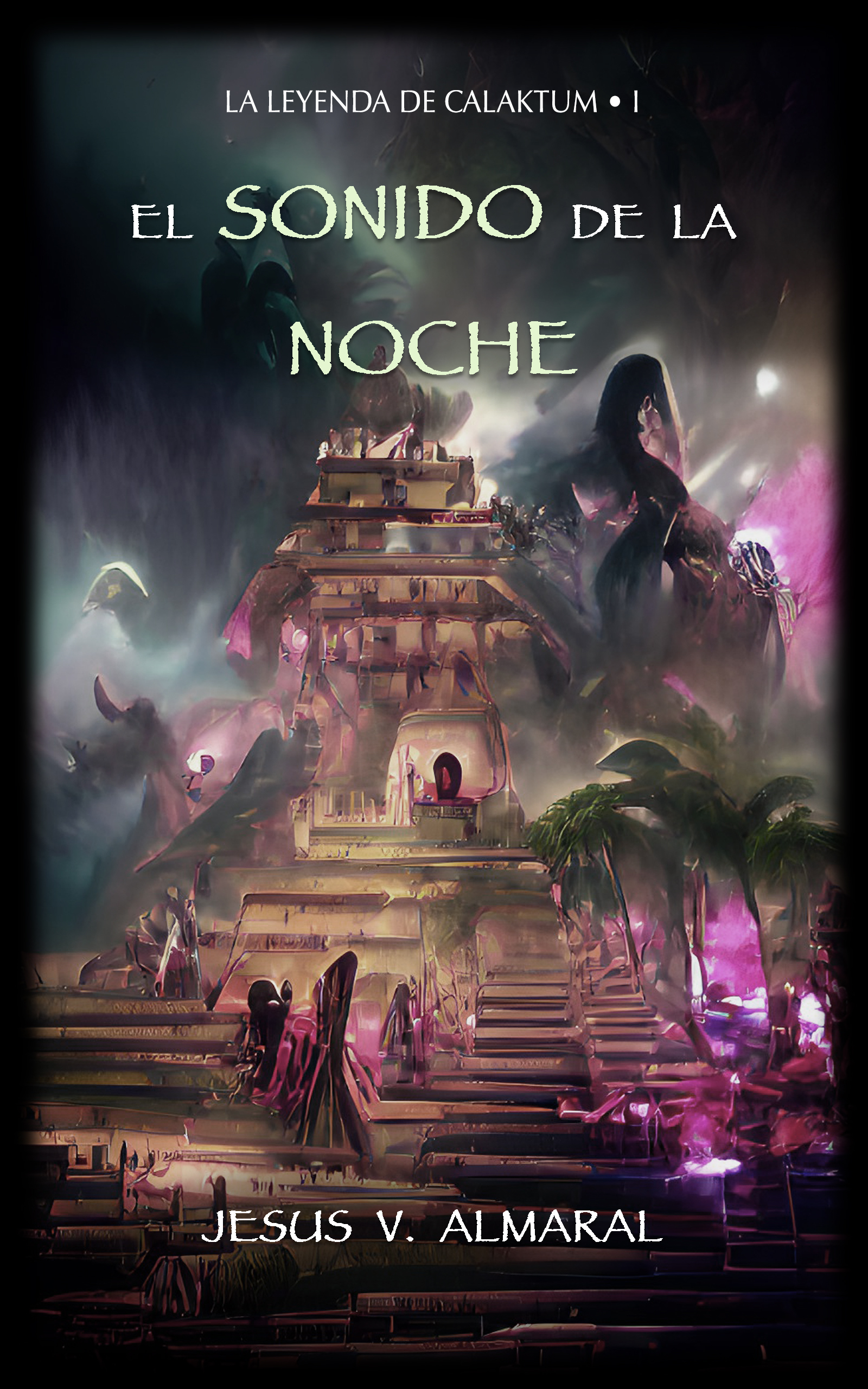
So without further ado, I leave you with The Legend of Calaktum I: The Sound of the Night, I hope you enjoy reading it as much as I enjoyed writing it.
Chapter 1
It’s a pleasure for me to share the first chapter of the book here, I hope you like it.
1. The Story Party
The morning would have been perfect if not for the war. It was a sunny day after several whole weeks of rain and storm clouds, the forest was completely tinted with the intense green that heralds a good spring and it would have been the perfect day to go exploring.
For as long as Iktan could remember, there had been wars in his world, some kingdoms against others always fighting to expand their territories, overthrow thrones or impose their ideologies, each one less sensible than the last.
But this war was different, it wasn’t a war against another kingdom, nor a conflict derived from the ego of some ambitious monarch, it was a war against fear itself, a war for survival.
Although that day Iktan didn’t think much about it, the war was still far to the South according to the travelers who had just passed through town and he was about to go with his friend Trop to explore a cave to the North, which they had heard about from old Bej. His concern was more focused on how he would convince his parents that their only son, just seventeen years old, wanted to embark on a three-day adventure, with the possible dangers that entailed. His mother Atle normally supported him in his adventures, but Kante, his father, didn’t agree much with what he called “his hobby with no future.”
Bej was Iktan’s grandfather and the oldest person in Okbe, the town where they lived. In his younger years he had been a town-to-town trader, better known as peddlers, so he had seen practically the entire world, from the cold hills to the North in Numpia to the jungle extreme to the South in Xa-log. There wasn’t a corner in the entire kingdom of Calaktum that Iktan’s grandfather didn’t know. Bej had a shelf full of the strangest objects in his room, some looked valuable and others seemed like just junk found by the roadside, but all of them had a story to tell.
Sometimes, Bej would disappear for a couple of days. Iktan didn’t know how he did it at such an advanced age and when he asked, he would only respond with a smile. He supposed he went out for long walks to remember his best years, although it had been several months since he had done this. Now the poor man was happy if his knees allowed him to walk through town from end to end. Bej was thin, short and brown like most in Okbe and Calaktum in general, a little hunched by age. Recently he carried a wooden cane that he refused to use, although he was forced to do so reluctantly. He also had completely white hair, although still abundant, and wrinkles he wore with pride that betrayed how much he had traveled, as well as hands that only someone who has worked daily for many years has.
Iktan and Trop loved spending time listening to Bej tell his stories, from there their love for trading had been born. Since they were little they went here and there looking for objects or food items like berries, mushrooms or grasshoppers that they later sold in a small store they had set up at Iktan’s parents’ inn or at the Okbe market, or that, if they really liked them, they added to their shared collection.
They had started exploring an abandoned corn mill on the outskirts of town where they found their first object, a piece of grinding stone. It wasn’t a pretty object, nor useful, or something they could sell, but they kept it for sentimental reasons.
They both enthusiastically remembered the first time they sold a rabbit they had hunted in the forest for three cocoa seeds and laughed like crazy every time they remembered when they had sold edible mushrooms for one cocoa per dozen to Pak’s family, the sandal seller, and that in the end turned out to be mushrooms of another type. Bej had had to take them an antidote when they heard the singing and saw them dancing outside their hut. Now Iktan and Trop were about to embark on their farthest exploration.
The day before, Bej had turned ninety-four and they had thrown him a party in the courtyard of Iktan’s parents’ inn. Since in addition to being the oldest in town he was also one of the most beloved, most of the town (about four hundred inhabitants) had attended the event. Even the two travelers who were passing through and staying at the inn took the opportunity to taste the dinner: turkey stuffed with fruits, with lots of shelled corn as a side and sweets of all kinds brought by Nima and his wife Nincanil, the good-natured and smiling sweet makers of Okbe, who were very good friends of Bej. After dinner, dancing, desserts (delicious plum, mango and papaya sweets) and everything that accompanies a proper party, came Iktan’s favorite moment: bonfire time, stories and news.
Everyone sat on stones and logs around a fire, except for the oldest, who were brought wooden chairs. These, as always, worried about the current situation, began asking the travelers about the war and what they knew about it.
After finishing his second plum candy bar the way only a traveler who hasn’t tasted a decent bite in weeks knows how, one of the travelers began to speak:
—We come from the town of Ixmal, two weeks’ journey to the South and so far there’s nothing to worry about, there are no signs of the Nazor yet, although they already took the city of Xa-log, the army has been able to hold them at the strait of Ko-lú.
—We must thank the God Yacail for those mountains —said Nicancil with a worried voice —it’s a relief that they help us stop the invaders.
—Yes, it’s a great help that nature favors us. The enemy is extremely fearsome, but as I already told you, for now we’re still in a safe zone and if they were to pass Ko-lú you would still have about a month’s head start to flee to the North.
—Also —continued the other traveler —in the worst case we can always have the help of the Tezcal, they say they’re the only ones who have been able to directly face the Nazor generals and come out alive.
—Don’t even name those demons —Nicancil responded again while continuing to distribute his sweets to everyone —just hearing their names scares me to death.
The first merchant took the floor again.
—Most of the Tezcal are still far to the North in their fortress of Te-Xun, only a couple of them accompany the army, it’s unlikely they can arrive in time to help us if we need it.
—Besides, rumors say there aren’t many Tezcal, and they don’t inspire confidence in me. They play with dangerous forces that even they don’t understand. They say they can move things without touching them, others say they can summon fire or spirits. I don’t think they’re much better than the Nazor —said Kante, Iktan’s father, with his thick tenor voice.
—I don’t think there’s anything worse than the Nazor —continued the first of the travelers, and this time his countenance became very serious, he lowered his voice almost to the extreme, as if fearing that someone could hear what he was about to say —no one knows where they come from or what they want, they leave no wounded nor take prisoners, but they don’t take anything of value either. Attempts to negotiate with them have ended in sacrificed messengers. Our army falls like flies in their path and there are those who say that if not for the Tezcal and the strait of Ko-lú they would already be upon us. They say they come from Xibalbá itself, hell, but I think they come from a deeper place.
The second traveler swallowed hard and continued speaking in the same tone as his companion.
—A traveling friend who survived the fall of Xa-log says he saw one of the Nazor generals. Among the tumult, the screams and his desperation to flee, he didn’t manage to see him well and says he doesn’t know if it was a hallucination caused by the fear he felt, but his eyes were so blue they almost seemed black, and he didn’t just mean the center of the eyes but also what surrounds them, the white part.
—It’s called the sclera —said the first traveler gobbling down a third huge piece of candy, this time mango, as if seconds before he hadn’t been talking about something so sinister.
—Well, whatever it’s called —continued the second traveler waving his hand —the point is they were very very blue, as if he saw the night sky in them, but that’s not all, his skin was as white as he had never seen before —the traveler cast a sidelong glance at Trop, Iktan’s friend, and his family, who were also white-skinned, and continued —and he had long white hair too. My friend says the monster turned to look at him for just a fraction of a second, and all he could see was amusement on his face, like someone who was winning a bet on a ball game, he didn’t seem like someone who was commanding the massacre of an entire town. My friend fled by miracle and when he told me this he was still trembling with dread.
Nima took the floor, also speaking seriously, something strange for him.
—According to the stories I’ve heard, the general your friend saw is Ixthel, one of the four Nazor generals, all equally evil.
There was a deep silence. For a few seconds that seemed like hours, only the sound of the wind, the hooting of owls, the singing of crickets and the crackling of fire could be heard. No one would think that moments before the atmosphere had been festive.
Atle, Iktan’s mother, stood up with an annoyed gesture.
—Enough scary stories, we’re celebrating my father’s birthday and the last thing we want is to think about wars that as the traveling gentlemen say are still far from here and will probably never arrive.
—You’re right Atle —Nima responded, changing his expression, smiling and encouraging everyone —it’s my good friend Bej’s birthday, and although I think I already know all his stories from beginning to end, I know how much he likes to tell his adventures and it’s always a pleasure to hear them again, plus it may be that the younger ones don’t know one or another. So Bej, I give you the floor to tell us one of your great stories.
Bej, who until that moment hadn’t said a single word, straightened in his birthday chair (sitting on a log or stone like the others gave him great back pain) and disguised his joy at being asked to tell one of his adventures, since for someone of his age this is one of life’s greatest pleasures.
—Thank you for the compliment friend Nima, it will be a pleasure for me to tell you a little of what I lived through in my years as a trader. But as always the biggest problem is choosing which story to tell —he said with an air of mystery.
—Tell about the time a Numpian tried to trick you and sell you unmeltable ice! —said one of the villagers.
—Or the time you found a fire quetzal nest in the middle of the great Xi-ca desert.
Now, it might seem strange that the whole town was excited to hear a story, but you have to take into account that in a small town like Okbe there wasn’t much else to do, plus Bej was extremely good at it. His words made you enter a world of reverie and imagine the things he narrated as if you had lived them yourself. So that night was full of stories, and not just from Bej. After a while some other villagers dared to tell their own tales and legends and even Nima, already with some mezcals in him, told about the time a rich man from one of the neighboring towns had offended his wife and he made him a basket of traditional sweets by order with very overripe fruits.
In the end everyone left for their homes, the travelers went to their rooms at the inn and only Bej, Iktan, his parents Atle and Kante and Trop, who was almost more Iktan’s brother than his own siblings, remained. Everyone was cleaning up the party remains. Iktan and Trop helped by sweeping and removing the stones and logs that had served as improvised chairs, Kante washed and dried the dishes and jugs, Bej put away the candy leftovers (pinching them every three steps) and Atle cleaned the kitchen.
Atle was a brown and short woman, with very long straight hair that reached her waist, black and hazel eyes and thin complexion, with skin so smooth it was difficult to guess her age. She was one of those women who wake up and are already bustling about and whistling happily before the rooster crows. She ran the house and managed the family business, which consisted of the town inn, also known as coacallis, which was right across the corner from the square where the market was set up and mainly served travelers like those that night. She was very good with numbers, and if not for her, Kante would have lost the property or spent the hard-earned money.
Kante for his part was a man of robust appearance, strong due to his work and somewhat taller than average, with a serious humor, stubborn and, if you didn’t know him well, you’d say someone with a bad temper, but deep down he was a good man. There wasn’t anyone in Okbe he hadn’t helped at least once, whether repairing their roof to prevent rains from flooding their house or giving free shelter at the inn to neighbors when their hut burned down. He dedicated himself to repairing, conditioning and building the furniture and rooms of the inn as required, and he professed an unconditional love for Atle. For him there was no other woman in the world.
Between both of them they took care of attending to guests and anyone who wanted to eat in their dining room. The inn consisted of a set of six huts, five of which were circular bedrooms and were behind a larger rectangular hut that served as reception and dining room, with a kitchen behind separated by a door with colored fabric curtain. They had started with just one bedroom and Kante had been building the others over the years. The plan was to build a sixth bedroom throughout that year to form two rows. The larger hut had an entrance at the front that faced the street and another at the back, which led directly to the courtyard with the bedrooms, and had a large table where guests all ate together. On busy days the dining room became chaos of conversations and dishes coming and going. Iktan and Trop took advantage of those days to make some sales. On the right side of the inn was a large courtyard with many trees all around and all fenced with crooked but well-arranged sticks. In this courtyard is where they had celebrated Bej’s party. At the back right was Bej’s hut, which he had requested as far away as possible from the others when construction of the inn began. Finally there was Iktan’s house, right next to the right of the reception. The house was on the same land as the inn, but separated by a small fence just to delimit the land. The entrance to his house didn’t face the street but toward the inn to have a view of the business. Iktan and his family used the inn’s kitchen for themselves too.
After a while of cleaning, Bej realized that Iktan hadn’t asked him for any story that night. It struck him as odd since he was always the first to ask for them.
—Iktan, is something wrong or why didn’t you ask for any story today?
Kante, Iktan’s father, frowned. He didn’t think it was right for Iktan to always be absorbed in adventures that led nowhere. But Iktan immediately asked something that, as strange as it may seem, hadn’t occurred to him before, but that night had him intrigued, only it seemed like a somewhat intimate question to ask in front of the whole village.
—Everything’s fine grandfather, it’s just that this time, more than asking you for a story I have a question. Of all the objects you have in your collection, which is your favorite?
Bej was thoughtful for a few seconds, as if deciding what to answer. Then looking at the others he said:
—What the hell! You’re old enough to know and I’m already old so what does it matter! I’ll answer your question but as always I’ll take the opportunity to tell its story.
And saying this he went to his room. After a few minutes he returned with a tiny basket made of wicker and closed with a cord. He untied it, opened the box and took out a leather rag, one of those that are so old they’re full of scratches and scrapes. He put it on the table and slowly extended it. Everyone approached to look with curiosity except Kante, who only looked sideways pretending to dry a jar with a rag.
What they saw didn’t surprise any of them. It was a white stone the size of a large marble. It had nothing special about it, it wasn’t shiny and didn’t seem to have any value. It was a simple stone, as if he had taken it from the river that morning. If anything, it could have been given a special attribute: it was totally round.
Iktan was a little disappointed. He thought he would see a precious stone or some ancient object of great value, but still out of courtesy he asked his grandfather, disguising his disappointment as best he could.
—Oh, it’s pretty. What is it?
—I know, it doesn’t seem like anything special —Bej responded with an amused gesture —but it’s more valuable than it appears. It’s so valuable that I hadn’t dared show it to you, my two best pupils. Only my daughter had seen it.
—You already knew about it mom?
—Yes, your grandfather has had it since before I was born, but let him tell you about it.
—Alright —Bej commented between thoughtful and entertained —I’m going to tell you a story I haven’t told anyone, not even my friend Nima knows its details. Only your grandmother, may she rest in peace, knew it, as well as Atle and after today, you. The story of why I decided to live in this town, the story of how I became a peddler and that even today still marks my life.
Jesus V. Almaral
349.00 |
99.00 |
Kindle 3,99 Physical 14,98 |
Kindle 4.90 Physical 13.95 |